Updated October 13, 2026
Bug Out Bag Checklist: 163 Items
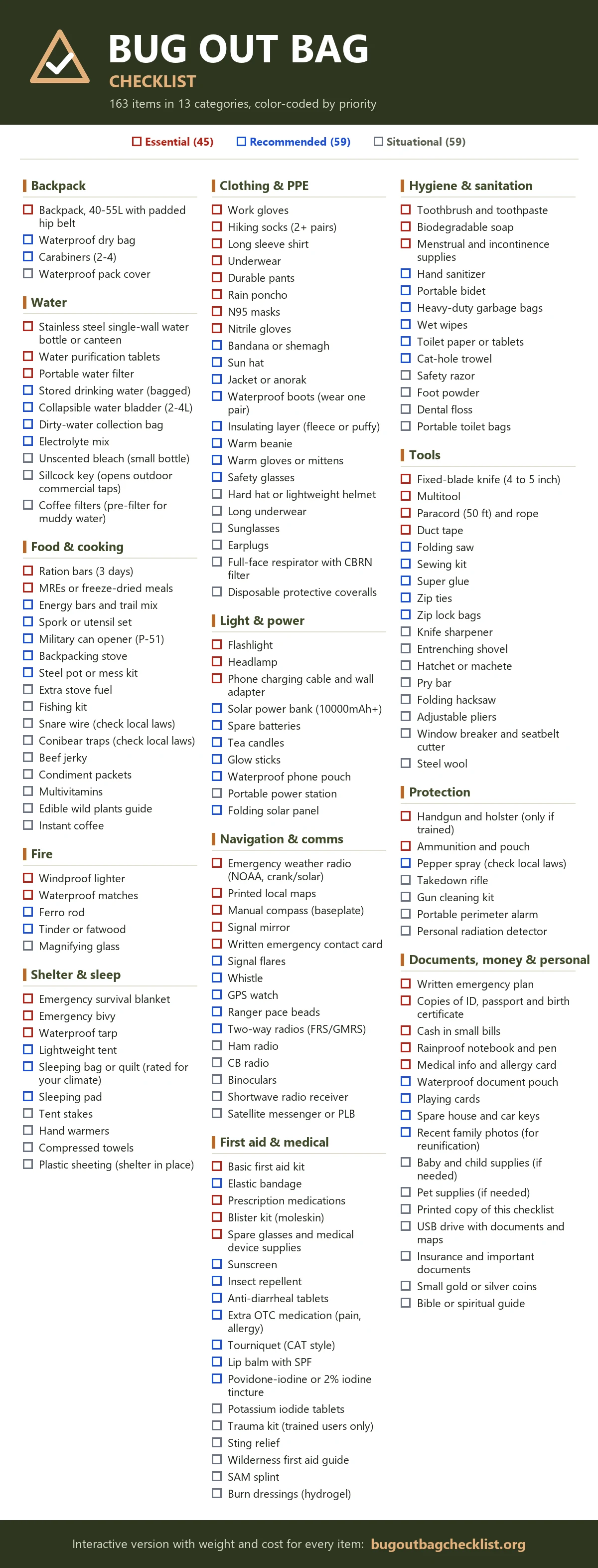
A bug out bag should hold what you need to survive 72 hours away from home: water and a way to purify more, food, shelter, fire, first aid, light, navigation, tools and copies of your documents. This checklist covers all 163 items worth considering, sorted into Essential, Recommended and Situational tiers, with a typical weight and cost for every one.
Start with the 45 Essentials. Add Recommended items that suit your household, then pick Situational gear for your route, climate and skills. Tick items as you pack: your progress saves on this device, and the toolbar adds up the weight and cost as you go. Switch off the situations that don't apply to you, such as Wilderness for a city evacuation, to hide gear you won't need.
Download the printable checklist
Prefer paper? The bug out bag checklist PDF fits all 163 items on two pages, with a tick box color-coded by tier beside each one and clickable product links. No email or signup needed.
Full checklist PDF
All 163 items on two pages, color-coded by tier, with clickable product links.
Download PDFEssentials on one page
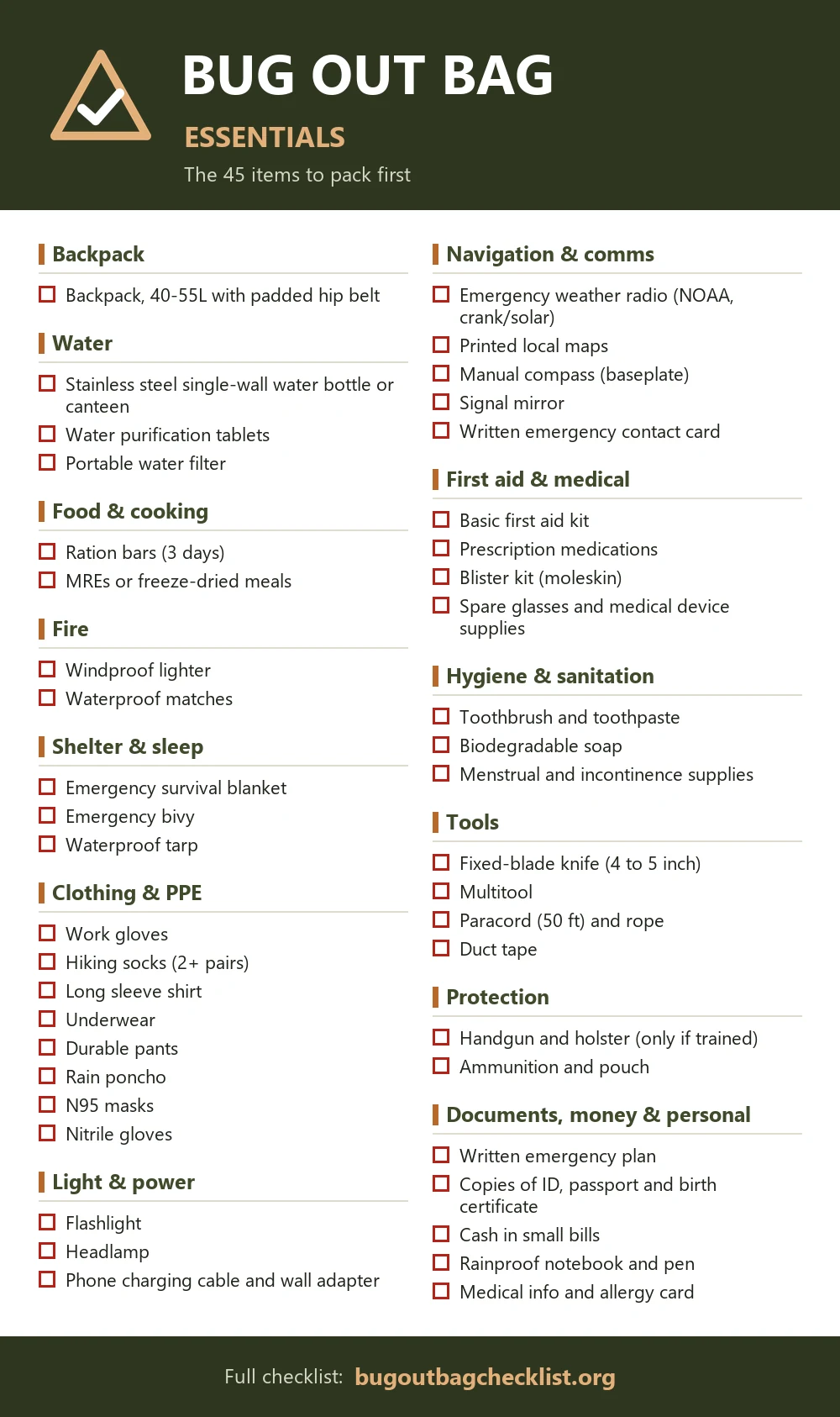
The 45 Essentials on a single sheet. Tape it inside your pack lid.
Download PDFSpreadsheet (CSV)
Opens in Google Sheets, Excel or Numbers so you can add your own gear and prices.
Download CSVMore printing options are on the printable bug out bag list page.
The 163-item bug out bag checklist
The complete bug out bag list: 163 items in 13 categories, each listed once. Nobody needs all of them, so every item has a tier to help you pack in stages, plus a typical weight and cost so you know what it adds before you buy.
Weights and costs are typical figures for a solid mid-range version of each item, not a specific product (last reviewed October 13, 2026). Treat the totals as a planning guide. Worn items, like boots, don't count toward pack weight.
Backpack 4 items
Everything else rides in the pack, so it is the first decision. Choose the pack style that suits your route, then protect what is inside it from rain.
-
Pick one pack: a 40 to 55 liter tactical bag, a framed hiking pack for long walks, or a plain grey-man pack that blends in on city streets.
-
A roll-top dry bag inside the pack keeps your sleeping bag, spare clothes and documents dry even when the pack itself soaks through in a storm.
-
#3Recommended
Two to four non-climbing carabiners clip a bottle, wet jacket or shoes to the outside of the pack and make quick anchors for a tarp line.
-
A fitted rain cover sheds water off the whole pack and adds a second layer of protection over the dry bag. Match it to your pack's liter size.
Water 10 items
You can last weeks without food but only about three days without water, and a gallon weighs over eight pounds. So the bug out bag carries a little water and several ways to make more safe to drink.
-
Single-wall steel can sit in a fire to boil water, unlike an insulated bottle. A canteen with a nesting cup works too. One liter is a practical minimum.
-
Chlorine dioxide tablets weigh almost nothing and kill the viruses most filters miss. Follow the label: wait times run from 30 minutes to four hours.
-
A hollow-fiber squeeze or pump filter makes streams and ponds drinkable fast. Most don't remove viruses, so keep tablets, and stash a cheap straw filter as backup.
-
Sealed water pouches store for years and let you drink while moving before you reach a source. They are heavy, so carry a few, not a day's supply.
-
A folding bladder rolls flat when empty and lets you haul extra water from a source to camp, or carry more through a long dry stretch.
-
A separate, clearly marked bag for untreated water keeps it away from your drinking containers. Many squeeze filters screw straight onto one.
-
Electrolyte packets replace the salts you sweat out on long, hot walks, help prevent cramps, and make treated water taste good enough to drink plenty.
-
#12Situational
Plain unscented bleach disinfects clear water when nothing else is left. The EPA's guidance for 6 percent bleach is 8 drops per gallon, then wait 30 minutes.
-
A four-way sillcock key opens the recessed outdoor taps on many commercial buildings. Useful in a city, but only with permission or in a genuine emergency.
-
#14Situational
Pour muddy water through a coffee filter first to strip out sediment so your filter doesn't clog. It does not make water safe on its own.
Food and cooking 16 items
Three days of food should be light, calorie-dense and need little or no cooking. The core items keep you fed; the situational ones are for longer trips or wilderness routes.
-
Emergency ration bars pack thousands of calories into a sealed brick that stores for about five years. Bland and dense, but built not to make you thirsty.
-
MREs include a flameless heater; freeze-dried pouches are lighter but need boiling water. Pack two or three meals, stripped of bulky outer packaging.
-
Familiar, calorie-dense snacks you can eat while walking keep energy up between meals, and children are far more likely to eat food they already know.
-
#18Recommended
A long-handled spork or a small utensil set reaches the bottom of meal pouches without getting food on your hands. Titanium or tough plastic both work.
-
#19Recommended
A P-51 can opener weighs next to nothing, lives on a key ring, and opens any can you find, are handed at a shelter, or bring from home.
-
A small canister stove boils water in minutes for meals, coffee or disinfection, and works in rain when lighting a cooking fire would be a struggle.
-
A steel pot or nesting mess kit boils water and cooks food on a stove or straight on coals. Store small items inside it to save space.
-
#22Situational
One spare fuel canister roughly doubles your hot meals and boiled water. Check the fit with your stove, and never store it next to the fire kit.
-
A pocket kit with line, hooks, sinkers and a few lures can add protein on a long trip near water. Fishing licenses and rules still apply.
-
#24SituationalWilderness only
Brass snare wire also repairs gear and lashes poles together. Snaring is banned or tightly regulated in many places, so learn your local rules first.
-
#25SituationalWilderness only
Body-grip traps are heavy, regulated and dangerous to pets and people. Most families should skip them; carry them only if you already trap legally.
-
#26Situational
Jerky is a light, high-protein snack that keeps for months sealed. It is salty, so count on drinking more water when you eat it.
-
#27Situational
A few salt, hot sauce and honey packets make bland ration food easier to eat, and honey is quick sugar when your energy fades.
-
#28Situational
A small bag of multivitamins covers nutritional gaps if you end up living on bars and packaged food for longer than you planned.
-
A regional field guide only helps if you have practiced with it beforehand. Never eat a plant you cannot identify with complete certainty.
-
#30Situational
Instant coffee sticks weigh almost nothing and head off the caffeine-withdrawal headaches that make a stressful evacuation even harder.
Fire 5 items
Fire means warmth, boiled water, cooked food and a signal. Carry at least two different ways to light one, and dry tinder to get it going.
-
Your fastest fire starter. A jet-flame lighter keeps burning in wind; a cheap disposable lighter stashed elsewhere makes a good backup.
-
Stormproof matches in a sealed case light even after a soaking. Keep them away from the lighter so one mishap can't take out both.
-
A ferrocerium rod throws hot sparks thousands of times, wet or dry. It takes practice, so learn to light tinder with it at home first.
-
Tinder is what turns a spark into a flame. Fatwood sticks, petroleum-jelly cotton balls or commercial tinder tabs all catch in damp weather.
-
#35SituationalWilderness only
A credit-card fresnel lens lights tinder in strong direct sun with no fuel at all. Slow and weather-dependent, but it never runs out.
Shelter and sleep 10 items
Exposure to cold, wind and rain can kill faster than thirst. The essentials here are light emergency shelter; the recommended items let you actually sleep.
-
#36Essential
Mylar space blankets reflect body heat, fold to pocket size, and double as a ground sheet or signal panel. Cheap enough to carry two.
-
An emergency bivy is a reflective sleeping sack you climb inside. It holds heat far better than a flat blanket and keeps wind off you.
-
A tarp is the most flexible shelter you can carry: a lean-to, an A-frame or a ground cover. An 8 by 10 foot tarp covers one or two people.
-
A one or two person backpacking tent gives full rain and bug protection. Heavier than a tarp, but worth it on longer trips or with children.
-
Choose a rating at least 10 degrees below the coldest nights in your region. Synthetic fill keeps working when damp; down is lighter but hates water.
-
Cold ground steals body heat all night through conduction. A closed-cell foam or insulated inflatable pad matters as much as the sleeping bag.
-
#42SituationalWilderness only
Spare lightweight stakes replace bent or lost ones and let you pitch a tarp tight in wind. A few extra weigh very little.
-
#43SituationalCold weather only
Air-activated hand warmers give hours of heat. Slip them into gloves, boots or the foot of your sleeping bag on a bitter night.
-
#44Situational
Coin-sized compressed towels expand into a washcloth with a splash of water. Handy for washing, cleaning a scrape, or as dry tinder.
-
#45SituationalNuclear or chemical only
Ready.gov lists plastic sheeting, scissors and duct tape for sealing a room when officials tell you to shelter in place during a chemical or radiation emergency.
Clothing and PPE 22 items
Pack for the worst weather your region sees in the season, wear the boots, and avoid cotton for anything close to the skin. Protective gear guards against smoke, debris and germs.
-
Leather or synthetic work gloves protect your hands from broken glass, rope burn and firewood. A hand injury slows down everything else you do.
-
Wool hiking socks dry faster and prevent blisters better than cotton. Change pairs daily and dry the spare on the outside of your pack.
-
#48Essential
A light synthetic or wool long-sleeve shirt blocks sun and insects and layers under a jacket. Avoid cotton, which stays wet and cold.
-
#49Essential
Two pairs of quick-dry underwear: one worn, one spare. Synthetic or merino fabric cuts chafing over long walking days.
-
#50Essential
Quick-drying hiking or work pants in a neutral color handle brush, rain and long distances. Skip jeans: heavy when wet and slow to dry.
-
A poncho covers you and your pack together and doubles as an emergency tarp. Pick a reusable one over a thin disposable sheet.
-
N95 respirators filter fine particles from wildfire smoke, dust and debris, though not gases. Pack several, since they stop working well once wet or dirty.
-
#53Essential
Disposable nitrile gloves protect you while treating wounds, handling dirty water or dealing with waste. Keep a few pairs in a zip bag.
-
#54Recommended
A bandana or larger shemagh scarf is a sweatband, dust mask, sling, pre-filter and sun shade in one. Cheap, light and useful every day.
-
#55Recommended
A wide-brim hat keeps sun off your face, ears and neck on long days outdoors. Heat and sunburn wear you down faster than people expect.
-
A waterproof, breathable shell blocks wind and rain over your warm layer. Make sure the hood fits and look for vents if you run hot.
-
#57Recommended
Wear broken-in boots rather than packing them. New boots on a long evacuation walk are a fast route to blisters, so break them in now.
-
#58Recommended
A fleece or synthetic puffy keeps you warm at night and during rest stops. Nights turn cold even in summer, especially once you are wet.
-
#59Recommended
A wool or fleece beanie keeps your head and ears warm and weighs almost nothing. Sleep in it to get more warmth from your bag.
-
Insulated gloves or mittens keep fingers working on cold nights. Numb hands can't light a stove, tie a knot or work a zipper, and work gloves aren't warm enough.
-
#61Recommended
Clear safety glasses protect your eyes from dust, debris and branches while you clear a path, cut wood or move through damaged areas.
-
Protects your head from falling debris after an earthquake, tornado or explosion, and while moving through damaged buildings. Clip it to the outside of the pack.
-
#63SituationalCold weather only
Merino or synthetic long underwear adds serious warmth for its weight. Sleep in it on cold nights and keep one set dry for camp.
-
#64Situational
Sun, snow and water glare cause eye strain and headaches over a long day. An inexpensive pair with UV protection is enough.
-
#65Situational
Foam earplugs help you sleep in a crowded shelter or a noisy camp. Rest is a survival tool, and these protect it.
-
Protects lungs and eyes from chemical, biological and radioactive particles, but only with the right filter and a good seal. Fit-test it and replace filters by date.
-
Hooded disposable coveralls keep ash, dust and fallout particles off clothes and skin. Take them off outside, bag them, then wash exposed skin.
Light and power 10 items
Plan as if the power is out for days. Carry two light sources that share a battery size, and a way to recharge your phone from the sun, not the wall.
-
A bright LED flashlight for searching and signaling. Pick one that runs on standard AA batteries, the same size as your headlamp, so spares work when you cannot recharge.
-
A headlamp keeps both hands free for shelter, cooking or first aid in the dark. Store it in a pocket you can find without looking.
-
#70Essential
Cables for every device, including medical or hearing devices, to charge from your power bank or solar panel. The wall plug matters once you reach a shelter with power.
-
Recharges a typical phone about twice, with a built-in panel for when the grid is down. That panel is small and slow, so charge the bank fully at home first.
-
Spare cells for your lights and radio. Lithium AA and AAA batteries are lighter than alkaline and hold their charge longer in storage.
-
#73Recommended
Tea lights give hours of soft light and a little warmth in a shelter. Use them only on a stable, non-flammable surface.
-
#74Recommended
Chemical light sticks glow for hours with no batteries and no flame. Good for marking a campsite or giving a child a safe light.
-
A sealed, touch-through pouch keeps your phone working in rain, floods and river crossings without taking it out.
-
Runs lights, radios and phones for days but weighs 10 pounds or more, so it suits a vehicle evacuation. Recharge it from the car or a solar panel.
-
With the power out, a folding panel is the realistic way to keep refilling your power bank on a long trip. Charge in full sun; output drops sharply in cloud or shade.
First aid and medical 18 items
Treat small problems before they become big ones. A basic kit and your own medications come first; trauma gear is for trained users.
-
Bandages, gauze, tape, antiseptic wipes, gloves and tweezers in a waterproof pouch. Know what is inside and how to use each piece.
-
An elastic wrap supports a sprained ankle or wrist and holds dressings in place. Rough ground and long walks make sprains one of the most likely injuries.
-
#95Essential
At least several days of every prescription, plus a written list of drug names and doses. Ask your doctor or pharmacist about an emergency supply.
-
Moleskin, blister dressings and tape. On a long walk, a hot spot ignored at mile five can stop you by mile fifteen, so treat it early.
-
#97Essential
Spare glasses or contacts, hearing aid batteries, and chargers or backup batteries for any medical device you depend on. Losing these mid-evacuation is a real handicap.
-
#98Recommended
Broad-spectrum sunscreen prevents burns that sap energy and break down skin. Reapply often if you are walking or working outside all day.
-
DEET or picaridin repellent protects against mosquitoes and ticks, which carry disease and make sleeping outdoors miserable.
-
#100Recommended
Loperamide tablets control diarrhea from unfamiliar food or water, which can dehydrate you quickly. They ease symptoms but don't treat the cause.
-
#101Recommended
Pain relievers, antihistamines and any other over-the-counter medicine you rely on. Blister packs keep them dry and labeled.
-
A windlass tourniquet stops life-threatening limb bleeding. Buy from a reputable seller, since counterfeits fail, and take a Stop the Bleed class.
-
#103Recommended
Lip balm with SPF stops cracked, sunburned lips, a small misery that gets worse every day spent in wind and sun.
-
Cleans wounds and doubles as backup water treatment: the EPA says 5 drops of 2% tincture per quart, 10 if cloudy, then wait 30 minutes.
-
#105SituationalNuclear or chemical only
Potassium iodide protects the thyroid only from radioactive iodine after a nuclear accident or attack. Take it only when public health officials tell you to.
-
#106Situational
Pressure bandages, hemostatic gauze, chest seals and trauma shears for serious injuries. Only useful if you are trained, so take a course first.
-
#107Situational
Sting relief wipes or gel ease bee, wasp and ant stings. Anyone with a known severe allergy should carry their prescribed epinephrine instead.
-
A pocket wilderness first aid guide walks you through injuries when help is hours or days away. Read it before you need it.
-
A rolled aluminum-foam splint molds to support a broken or sprained limb. Light and reusable; earthquakes and debris make fractures more likely.
-
Hydrogel dressings cool and cover burns from fires, stoves or explosions. Standard first aid kits rarely carry enough of them.
Hygiene and sanitation 13 items
Staying clean prevents infection and sickness, and it keeps morale up. These are small, light items that pay for themselves on day two.
-
#111Essential
A folding toothbrush and a travel tube of toothpaste. Brushing feels minor, but it keeps you healthy and lifts morale on day three.
-
Concentrated camp soap cleans hands, dishes and scrapes. Wash at least 200 feet from streams and lakes, even with biodegradable soap.
-
#113Essential
Pads, tampons, a menstrual cup or incontinence products for anyone who needs them. Supplies can be scarce in shelters, so pack more than you expect to use.
-
#114Recommended
Sanitizer with at least 60 percent alcohol cleans hands when water is short. It works poorly on visibly dirty hands, so wash when you can.
-
A squeeze-bottle bidet cuts toilet paper use and keeps you cleaner over days without a shower. It folds flat in a side pocket.
-
#116Recommended
Heavy contractor bags line your pack, become a poncho, ground sheet or emergency toilet, and hold dirty clothes.
-
#117Recommended
Wet wipes clean hands, faces and bodies when water is scarce. Pack a resealable travel pouch and carry used ones out.
-
A flattened roll sealed in a zip bag, or compressed tablets that expand with a drop of water. Tablets are lighter and smaller; keep either one dry.
-
Bury human waste 6 to 8 inches deep and well away from water. A light trowel makes that quick, even in hard ground.
-
#120Situational
A safety razor with a few spare blades keeps you groomed for weeks. Shaving matters if you need a mask to seal properly.
-
#121Situational
Foot powder keeps feet dry and helps prevent blisters and fungal problems on long walks. Dust it in your socks each morning.
-
#122Situational
Floss cleans teeth and doubles as strong thread for sewing gear or lashing small repairs.
-
Gelling toilet bags turn a bucket or a broken toilet into a sanitary one when water and sewer service fail after a flood or earthquake.
Tools 17 items
A good knife, a multitool, cord and tape handle most jobs. The heavier tools further down are for wilderness routes or vehicle kits.
-
A full-tang fixed blade handles food prep, shelter building and splitting kindling. A Scandi-grind bushcraft knife is a good alternative. Check local knife laws.
-
Pliers, screwdrivers, a small blade and a saw in one tool. It handles the hundred small jobs that a big knife is clumsy at.
-
Fifty feet of 550 cord rigs a tarp line, replaces a bootlace and lashes gear. Add thicker rope only if you expect heavy hauling.
-
#127Essential
Wrap a few yards around a bottle or old card to save space. It patches gear, holds a splint and covers blister dressings.
-
A folding saw cuts firewood and shelter poles faster and more safely than a knife or hatchet, with less effort.
-
#129Recommended
Needles, strong thread and a few buttons fix torn straps, seams and clothing before small damage becomes a failure.
-
#130Recommended
Single-use tubes of super glue repair boot soles, cracked plastic and split gear in seconds. Buy small tubes so leftovers don't dry out.
-
#131Recommended
A handful of zip ties fixes broken buckles, secures gear to the pack and replaces lost fasteners in seconds.
-
#132Recommended
Zip-top freezer bags waterproof your phone, documents, first aid kit and fire kit. Pack a few spares.
-
#133Situational
A pocket sharpener keeps your blades working. A dull knife slips, and a slipping knife causes injuries.
-
#134SituationalWilderness only
A folding shovel digs fire pits, drainage trenches and latrines. Heavy for walking, so it suits vehicle or base-camp plans.
-
#135SituationalWilderness only
A hatchet splits firewood; a machete clears thick brush. Carry one, only for wilderness routes or a fixed camp. A folding saw is lighter for most jobs.
-
#136SituationalCity only
A small pry bar opens jammed doors and shifts debris after an earthquake or storm. Useful in damaged buildings, heavy on a long walk.
-
#137SituationalCity only
A folding hacksaw cuts metal, chain and plastic pipe when you need to get past an obstacle. Mostly an urban or vehicle tool.
-
#138Situational
Adjustable pliers or a wrench let you shut off gas or water at the meter when officials advise it, plus general repairs.
-
A spring-loaded window punch and belt cutter on your keychain can get you out of a car trapped in floodwater or after a crash.
-
#140Situational
Fine 0000 steel wool catches from a spark or a 9-volt battery and keeps burning when damp. A simple, cheap fire backup.
Protection 7 items
These items are personal choices that come with legal and training responsibilities. Laws on firearms, knives and pepper spray differ by state and city, so check them for every place on your route.
-
#141Essential
Only if you are trained, legally allowed to own one, and know the carry laws on your whole route. Use a holster that covers the trigger guard.
-
#142Essential
A modest supply in the right caliber, in magazines or a pouch. Ammunition is heavy, and transport rules vary between states.
-
#143Recommended
A less-lethal deterrent for people and animals. Size, strength and legality vary by state and city, so check local laws before carrying.
-
#144SituationalWilderness only
A takedown rifle breaks down to fit inside or on a pack. Same rule as any firearm: training, legal ownership and knowledge of local law come first.
-
#145Situational
A compact cleaning kit keeps a firearm reliable after rain, mud or dust. Pick one sized for your caliber.
-
A battery motion or tripwire alarm warns you of anyone approaching your camp or shelter door while you sleep.
-
A pocket dosimeter or radiation alarm shows whether fallout is present and how strong it is. Buy a calibrated unit from a reputable maker.
Documents, money and personal 16 items
The paperwork you will need to prove who you are, claim insurance and find your family, plus a few things for comfort. Keep it all in a waterproof bag.
-
#148Essential
A one-page plan with evacuation routes, meeting places and an out-of-area contact. Ready.gov offers free family plan templates.
-
#149Essential
Copies of each person's ID, passport and birth certificate prove identity and family ties at shelters and checkpoints, and speed replacement if originals are lost.
-
#150Essential
Card readers and ATMs fail in power outages. Carry a few hundred dollars in small bills, since nobody may have change.
-
#151Essential
An all-weather notebook and pen for notes, messages to leave behind, and a log of injuries, medications and events. Both work wet.
-
#152Essential
Blood type, allergies, conditions, medications and doctor contact for each person. Responders can help faster when they have this.
-
A zip-sealed waterproof pouch keeps ID copies, insurance papers, cash and your plan dry and together, in one place you can grab fast.
-
#154Recommended
A deck of cards passes long hours in a shelter or car and keeps children occupied. Morale is part of survival.
-
#155Recommended
Spare house and car keys mean you can still drive or get home if your main set is lost or left behind in the rush.
-
#156Recommended
Recent photos of each family member and pet help responders and shelters reunite you if you are separated.
-
#157Situational
Formula, bottles, diapers, wipes, diaper cream, a change of clothes and a comfort item for at least three days. Essential for any household with babies or toddlers.
-
#158Situational
Food, water and bowls for three days, a leash or carrier, medications, vaccination records and a photo of you with your pet. Essential if you have animals.
-
#159Situational
Tape the printed checklist inside the pack lid so you can check contents during maintenance and repack after use.
-
An encrypted USB drive holds scans of documents and insurance, family photos and offline maps. Encryption protects you if the drive is lost.
-
#161Situational
Copies of home, auto and health insurance policies with claim numbers speed up recovery after a disaster.
-
#162Situational
Precious metals store value but are hard to spend in an emergency. Cash comes first; treat a few small coins as an optional extra.
-
#163Situational
A small Bible or other spiritual text brings comfort during a long emergency. Pick whatever helps you stay steady.
No items match these filters.
What is a bug out bag?
A bug out bag is a backpack you pack ahead of time so you can leave home within minutes and live out of it for about 72 hours. Wildfires, hurricanes, floods, chemical spills and gas leaks can all force an evacuation with little warning, and the first three days are when stores are closed, roads are jammed and emergency services are stretched thin. The American Red Cross recommends a three-day supply of water and food for evacuation, and Ready.gov, FEMA's preparedness site, builds its basic kit around the same idea.
The bag is only half the job. It works best alongside a bug out plan: where you will go, two or three routes to get there, where your household meets if you get separated, and an out-of-area contact everyone can call. Write the plan down and keep a copy in the bag; it is on the checklist under Documents.
Pack one bag per person. Each adult carries their own clothes, water and sleep gear, and older children can carry a small bag of their own. Spread the heavy shared items, like food, water and the stove, across several bags, so losing one bag doesn't leave the group without water or meals.
Not every emergency means leaving. In a chemical, radiation or nuclear emergency, officials may tell you to shelter in place instead. Your bug out bag doubles as that kit, and the items marked "Nuclear or chemical" on the checklist cover the extra gear, from potassium iodide to plastic sheeting.
You will see the same kit under other names:
- Go bag: the term most emergency managers and news reports use.
- 72-hour kit: named for the three days it is meant to cover.
- Bail-out bag and evac bag: common among the military and first responders.
- GOOD bag: short for "get out of Dodge."
- SHTF bag: prepper shorthand for a bag built for a serious, long-lasting emergency.
- Prepper bag: a catch-all for any packed emergency bag.
Whatever you call it, the prepper bag checklist above works the same way.
The 45 bug out bag essentials
If you only pack one tier, make it this one. This bug out bag essentials list covers water, food, shelter, fire, first aid, light, navigation and documents for a 72-hour evacuation. One thing to know: the two firearm items apply only to trained, legal owners. Without them, the Essentials come to 43 items, about 18 pounds and $822 at typical prices.
Tick them off in the full checklist, or print the one-page Essentials PDF.
Water
Food and cooking
Shelter and sleep
Clothing and PPE
Light and power
Navigation and comms
First aid and medical
Hygiene and sanitation
How to pack a bug out bag
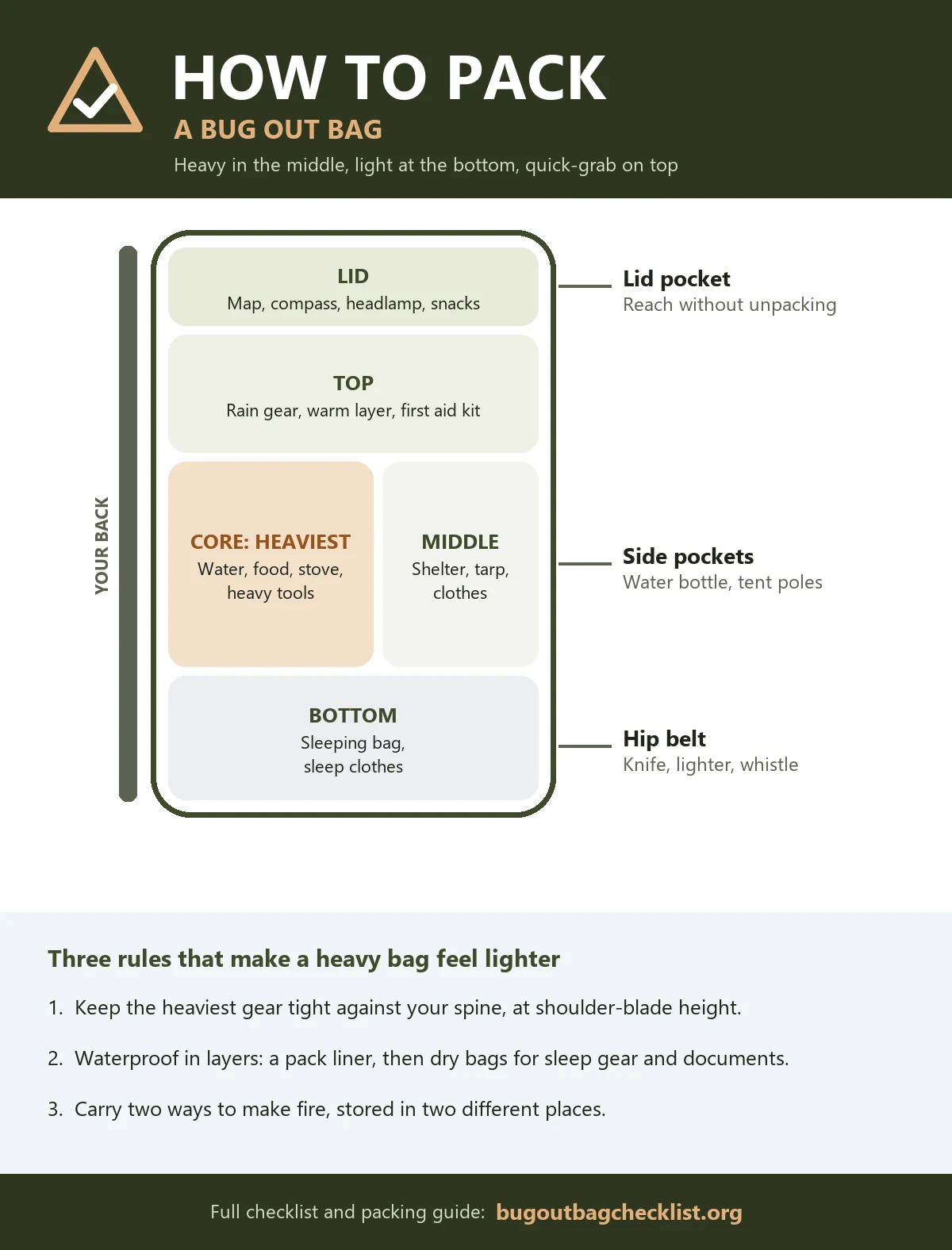
A good packing order makes a 30-pound bag feel lighter and lets you reach what you need without emptying everything onto the side of a road. Use this as your bug out bag packing list order:
- Heavy items close to your back. Water, food, the stove and heavy tools go in the middle of the pack, tight against your spine and roughly level with your shoulder blades. Weight held close to your body pulls you backward less and keeps you balanced on rough ground.
- Light, bulky items at the bottom. The sleeping bag and sleep clothes fill the bottom, since you won't need them until you stop for the night.
- Grab-fast items on top and in the lid. Rain gear, the warm layer, first aid kit, headlamp, map, compass and snacks should be reachable in seconds.
- Small essentials on your body. Keep a knife, lighter, whistle and a little cash in a hip-belt pocket or on you, so losing the pack doesn't mean losing everything.
- Waterproof in layers. Line the pack with a dry bag or a contractor bag, then seal the sleeping bag, spare clothes and documents in their own dry sacks or zip bags.
- Roll clothes into skivvy rolls. Roll a shirt around a pair of underwear and socks, then fold the hem over the ends to lock it into one tight bundle. One roll per day keeps clothes compact and easy to find.
- Split your fire kit. Carry two ways to make fire in two different places, such as a lighter in your pocket and stormproof matches in the pack, so one soaking can't take out both.
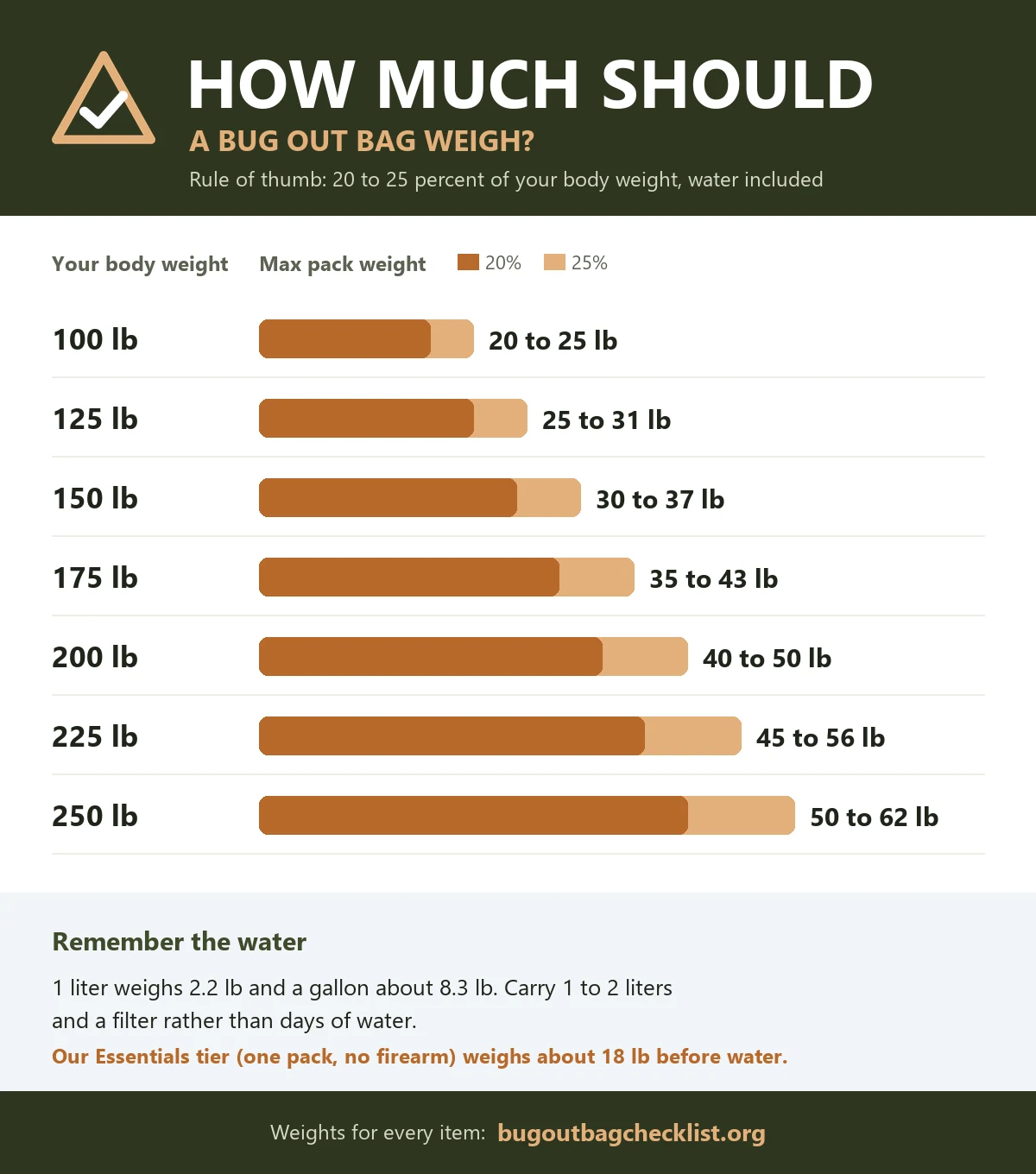
Water is the weight you can't avoid. A liter weighs 2.2 pounds and a gallon about 8.3 pounds. The Red Cross suggests a gallon per person per day for drinking and sanitation, which would add over 25 pounds for three days. That is why this checklist pairs one or two liters of carried water with a filter, tablets and a collapsible bladder for refilling along the way.
How much should a bug out bag weigh?
A widely used backpacking rule of thumb says a loaded pack should weigh no more than 20 to 25 percent of your body weight. For a 150-pound adult that means 30 to 37 pounds; for a 200-pound adult, 40 to 50 pounds. Children, older adults and anyone with back or knee problems should aim lower. Water counts toward the total.
Here is what the checklist adds up to, using the typical weights and costs shown on each item:
| What you pack | Weight | Cost |
|---|---|---|
| Essentials only: one pack, no firearm (43 items) | 18 lb | $822 |
| Essentials plus 2 liters of water | 23 lb | $822 |
| All 59 Recommended items | 20 lb | $1,448 |
| Essentials plus every Recommended item | 38 lb | $2,270 |
The Essentials with water land inside the 20 percent target for most adults, with some room left for Recommended items. Packing every Recommended item as well is too heavy for most people, which is the point of tiers: choose from them rather than carrying them all. Prescriptions, cash and other items without a set price aren't included in the cost figures.
To build a lightweight bug out bag, cut weight in this order:
- Choose the smallest pack that fits your Essentials; extra space invites overpacking.
- Use the tarp and bivy instead of a tent.
- Rely on a filter and tablets rather than extra stored water.
- Strip food out of bulky outer packaging.
- Walk with the loaded bag for an hour. Anything you never touched is a candidate to leave behind.
Building a bug out bag on a budget
Bought new at typical prices, the Essentials (one pack, no firearm) run about $822. Few people need to spend that. Here is how to build a budget bug out bag for much less.
- Start with the Essentials. Filter the checklist to Essential and buy in the order that keeps you alive: water treatment, shelter, fire, first aid, then light.
- Use what you already own. An old school backpack, hiking clothes, a kitchen pot, a spare phone cable and last year's glasses all count. Tick those off first; you may be halfway there.
- Shop secondhand for the big items. Thrift stores, garage sales and online marketplaces are full of barely used packs, sleeping bags and jackets. Buy water filters, medical supplies and anything safety-critical new.
- Spend where failure is dangerous. Put your money into the water filter, tourniquet, headlamp, footwear and a sleeping bag rated for your climate. Cheap bandanas, cordage, duct tape and zip bags work just as well as expensive ones.
- Buy a little each month. The checklist saves your progress, so you always know what is left.
Bug out bags for kids, family and pets
A family bug out bag is really several bags. Each adult carries a full kit, and children carry what they can manage: their own clothes, a water bottle, snacks, a flashlight, a whistle and a comfort item. Adults carry the shared gear and the extra food and water. For a bug out bag list for a family of 4, run this checklist once per adult, then add the items below.
- Babies and toddlers: formula, bottles, diapers, wipes and diaper cream for at least three days, plus a carrier so your hands stay free.
- Children: a laminated card in each child's bag with their name, your phone numbers and your meeting place, and a recent photo of each child in yours. Add a small toy, book or game, and refit clothes and shoes as they grow.
- Older adults and anyone with medical needs: extra medication, spare hearing aid batteries, glasses, mobility aids and copies of prescriptions.
- Pets: food and water for at least three days, bowls, a collar with ID tags, a leash or harness with a spare, a carrier, medications, copies of vaccination and registration records, and a current photo of you with your pet. Not every shelter accepts pets, so note pet-friendly hotels or boarding along your route.
Types of bug out bags
The bug out bag sits in the middle of a family of emergency kits. Here is how it compares with the others you will hear about.
- Get home bag
- A smaller kit kept at work or in the car, built to get you home on foot over a day or so if disaster strikes while you are away. Think water, snacks, walking shoes, a light, a map and a rain layer.
- INCH bag
- Short for "I'm Never Coming Home." A larger, heavier kit for leaving for good, with more tools, more ways to get food and more backups than a 72-hour bag. Much of the Situational tier belongs here.
- EDC kit
- Everyday carry: what is on you every day, such as a phone, a knife or multitool, a small light, a lighter and some cash. Your EDC is the kit you will actually have when trouble starts, so it is the natural next step after the bug out bag.
- Vehicle kit
- Stays in the car: jumper cables, water, blankets, a first aid kit, a flashlight, a tow strap and seasonal gear such as an ice scraper. If you evacuate by car, it adds to your bug out bags rather than replacing them.
- 72-hour kit or go bag
- Usually the same thing as a bug out bag, named for its three-day purpose. Some people use "72-hour kit" for a home emergency supply that stays put, so check what a list means before you copy it.
Keep your bag ready: the six-month check
A bag packed three years ago and never opened is full of expired food, dead batteries and clothes that no longer fit. Set two reminders a year, for example when the clocks change in spring and fall, and work through this list:
- Rotate food, water and medications before they expire.
- Test lights, radios and power banks, and recharge or replace batteries.
- Swap clothing for the coming season and refit children's sizes.
- Update documents, phone numbers and your written plan.
- Re-read this checklist for anything your household now needs, such as a new baby, pet or prescription.
Ready.gov gives the same advice in its kit guidance: replace expired items as needed and rethink your needs every year as your family changes.
Bug out bag checklist FAQ
What should I put in a bug out bag first?
Start with what keeps you alive for 72 hours: water and a way to purify more, food, shelter from the weather, two ways to make fire, a first aid kit with your own medications, a light, and copies of your ID. That is the Essential tier. Filter the checklist to Essential to see all 45.
How many items should a bug out bag have?
There is no magic number. This list has 163 items, but nobody needs all of them. The 45 Essentials cover a 72-hour evacuation for most people. Add Recommended and Situational items that fit your climate, route and skills, as long as you can still carry the bag comfortably.
How much should a bug out bag weigh?
Aim for no more than 20 to 25 percent of your body weight, including water. For a 160-pound adult that is 32 to 40 pounds. The Essentials on this checklist, with one pack and no firearm, come to about 18 pounds before water.
What size backpack is best for a bug out bag?
For most adults, 40 to 55 liters. Smaller packs force you to leave out shelter or water, and bigger ones invite overpacking. Choose a pack with a padded hip belt that fits your torso length, and load it to test the fit before you buy.
Is a bug out bag the same as a go bag or 72-hour kit?
Mostly, yes. Go bag, 72-hour kit, evac bag, GOOD bag and bail-out bag all describe a pre-packed bag that gets you through about three days away from home. A get home bag is smaller and an INCH bag is much bigger.
Should I carry a gun in my bug out bag?
Only if you are trained, legally allowed to own one, and know the carry and transport laws for every place on your route. Many emergency shelters prohibit weapons. A firearm adds weight, cost and responsibility, and most people are better served by spending that money on water, medical and shelter gear first.
How often should I check my bug out bag?
Every six months. Rotate food, water and medications before they expire, test batteries and electronics, and refit clothing for the season and for children who have grown. Ready.gov also advises rethinking your kit every year as your needs change.
Is a pre-packed bug out bag worth it?
A pre-packed kit is a quick start, but many include low-quality filler and leave out personal items such as medications, documents and glasses. If you buy one, check it against this list, upgrade the knife, light, water filter and shelter, and add your personal items.
How this checklist was built
We compared the most widely referenced bug out bag lists, merged duplicates and alternatives so no item appears twice, which leaves 163 distinct items. We added gear those lists often leave out, such as a warm layer, blister care, a tourniquet, two-way radios and a medical information card, plus war and disaster gear like a respirator, a radiation detector, iodine and shelter-in-place sheeting. Each item was then tiered by how much it matters on a typical 72-hour evacuation. Where the list overlaps official guidance, it follows it:
- Ready.gov: Build a Kit (FEMA)
- Ready.gov: Make a Plan
- Ready.gov: Radiation Emergencies
- Ready.gov: Prepare Your Pets for Disasters
- American Red Cross: Survival Kit Supplies
- US EPA: Emergency Disinfection of Drinking Water
- Stop the Bleed (bleeding control training)
This page is general preparedness information, not legal or medical advice. Laws on firearms, knives, pepper spray, trapping and radio use vary by location; check yours.
Bug out bag checklist infographics
Prefer a picture? These graphics sum up the checklist at a glance. Save them to your phone, print them, or share them on Pinterest, a blog or a community page. They are free to use; please link back to this page.